This blog post examines the history of money and the risks of today’s monetary fiat system. As we will outline in this article, historically all fiat systems have eventually failed and led to a return of hard money. Could Bitcoin be our next version of hard money? Sit back, relax and let us walk you through the history of money:
What is money?
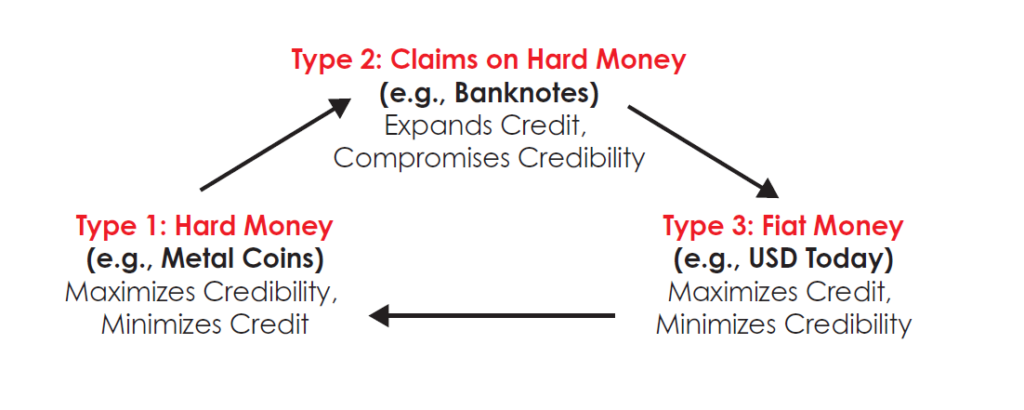
Civilisations have used many things as money throughout human history. Ray Dalio, the founder of Bridgewater Associates, outlined in his recent book “The Changing World Order” that any money used by civilisations can be categorized into 3 types of money:
Type 1: Hard money refers to a currency that is made up of a valuable and limited commodity. Most often this limited commodity has been precious metals (gold & silver). Think of the gold coins in the antics & Europe’s middle-age or the global dominant gold standard in the 19th century. The advantage of this form of money is that it requires no trust and it can be settled on the spot, even if the buyer and seller are strangers or enemies.
Type 2: Claims on Hard Money: Because carrying a lot of metal money around is risky and inconvenient, credible parties arise that put the hard money in a safe place and issue paper claims on it. The institutions to issue these claims could be temples (in ancient China), commercial banks or central banks. If the institution is trusted enough, people will soon treat these paper claims on money as if they are money itself because they are linked to an underlying hard currency which can be reclaimed.
Type 3: Fiat Money: While type 2 money allows states to issue credit to finance their debt, the link to hard money restricts the amount of money that can be issued. However, over time governments yield to the temptation to issue money beyond the held reserves. When people realize that the claims have become significantly bigger than the reserves, they will want to redeem their claims. This will force the central bank/governments to give up on their promise of convertibility for hard money and introduce a system under which they can create credit & money freely (This shift last happened with the end of Bretton Woods System in 1971).
Most investors are aware of this transition from hard money to the Fiat standard of today and are led to believe that this is the natural evolution of things with Fiat money being the superior monetary system. However, Dalio in his book demonstrates that humans have used the Fiat monetary system at various points in history before and that each time the shortcomings of the system led people to return to type 1 money (hard money). Therefore, in his view societies constantly transition between the various types of money and the Fiat system should not be thought of as an end state, but rather as a transitory phase.
Why have Fiat systems always failed in the past?
Dalio argues that all fiat systems will eventually experience a debasement of money and end with a return to hard money. According to his research, governments have eventually always yielded to the temptation of manufacturing money and credit and distribute them:
“Throughout history, rulers have run up debts that won’t come due until long after their own reigns are over, leaving it to their successors to pay the bill.”
Why did they do that? In theory, a government under a fiat system has four ways to finance the debt in a crisis:
- Spending less (Austerity)
- Raising taxes (Transfers)
- Debt default/restructuring
- Printing money
First let’s look at three examples in the history of fiat money systems, to examine what leaders of those systems eventually resorted to and what consequences it had for the value of money:
- Medieval China (Song, Yuan and Ming Dynasties 12th to 16th century): In several occasions over the centuries, the governments of the time tried fiat monetary systems but resorted to money printing in times of war or catastrophe, which caused (hyper-)inflation and each time led to a return to silver or gold backed currencies.
- Dutch Empire: The Dutch Guilder issued by the Bank of Amsterdam was the leading reserve currency in Europe from the 16th to 18th century. Initially the currency was linked to the value of silver, but as the Dutch Empire lost power and the economic problems got worse the Bank of Amsterdam switched to a fiat system. In 1781 it started printing more and more paper money to provide loans to the Dutch East India Company, the Dutch Government and the City Chamber. In the two decades that followed, the dutch guilder lost 80% of its value and its status as a reverse currency as people sought the safety of gold/silver or linked currencies (GBP).
- Weimar Republic: During the first world war, Germany suspended the convertibility of their currency to gold and financed the war solely by issuing debt (move from type 2 to type 3: fiat money). After its defeat in WWI, it had accumulated huge amounts of debts and war reparations. The Weimar government was forced to print even more money to repay that debt and meet reparation payments which eventually led to a total devaluation of the currency by 1923 (through hyperinflation).
In all historic examples of fiat systems, political leaders eventually resorted to money printing. The first time they started creating money without backing they did so to avert a great crisis (e.g. a war or a pandemic), but once pandora’s box was opened, each successive crisis called for more printing, eventually leading to a devaluation of the fiat currency and a return to hard money.
In recent years, our political leaders have also faced many crises. And they too resorted to printing money to deal with them (Financial crisis of 2008, Euro crisis 2011, COVID crisis 2020). It has become a standard procedure for central banks to meet any crisis with more money printing. But as the historic examples have shown us: when the printing of fiat currency is taken too far, it will create a “bank-run” like dynamic, with investors fleeing out of currency and debt into assets that maintain their real value, leading to devaluation of the fiat currency and a return of hard money.
What could the hard money of the 21st century be?
1. Gold
Gold has historically been the best store of value and in times of monetary crisis people have returned to the safety of gold. The reason why gold emerged as the most popular form of hard money can be boiled down one key factor: Scarcity
But for a resource to be scarce and valuable over time, its production (flow) must be small compared to its existing supply (stock). Because a currency can only be “hard” if the emission/production of new money is limited compared to the amount of money in circulation. Even if the price of gold rises rapidly, the extraction of additional gold reserves stays very difficult, thereby limiting the growth of the supply in gold (in fact the annual production of gold never exceeded 2,6% of the existing stocks). As the economist Saifedean Ammous argues: other precious metals such as silver or bronze are much simpler to extract and any substantial increase in price will lead to a large increase in production, which will bring the price for these metals back down.
Looking at the last 100 years, gold was indeed a very good store of value and on average outperformed investments in government bonds in most countries except Switzerland.
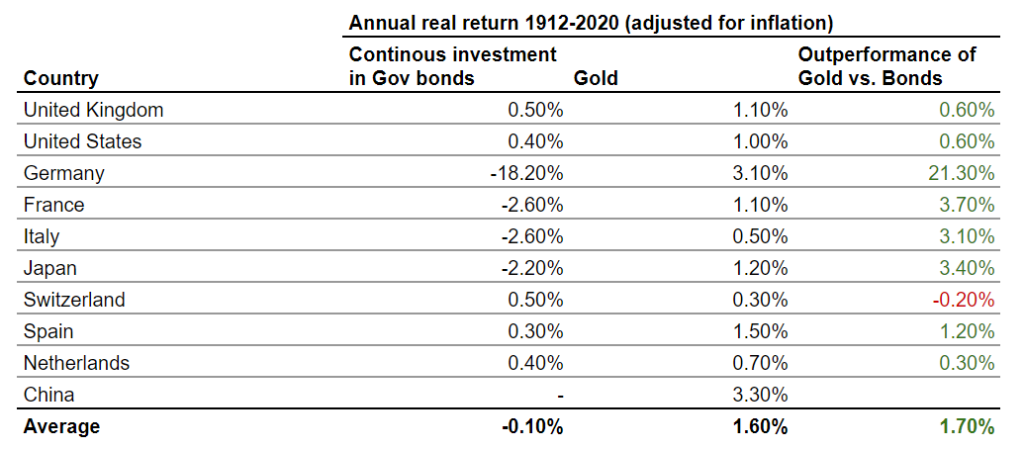
While gold certainly has the longest track record as hard money around the world, it is also important to note that an investor in gold would have been subject to confiscations or bans in many places over those 100 years (e.g. gold was banned in the US from the mid-1930s to the mid-1970s).
2. Bitcoin
In our view, Bitcoin has the potential to become another form of hard money for the 21st century. Because its creator was the first to solve the problem of digital scarcity: The built-in incentive mechanism for miners across the distributed network to verify transactions in exchange for fees and block subsidies, creates a decentralised ledger system with a limited supply. There will never be more than 21 million Bitcoins in existence, of which 19.2 million (91%) are already circulating today. In 2023 the programmed annual inflation will be 1.7%, which is comparable to the emission of gold. However, the emission of Bitcoin is programmed to half approximately every 4 years until the total supply reaches 21 million Bitcoins.
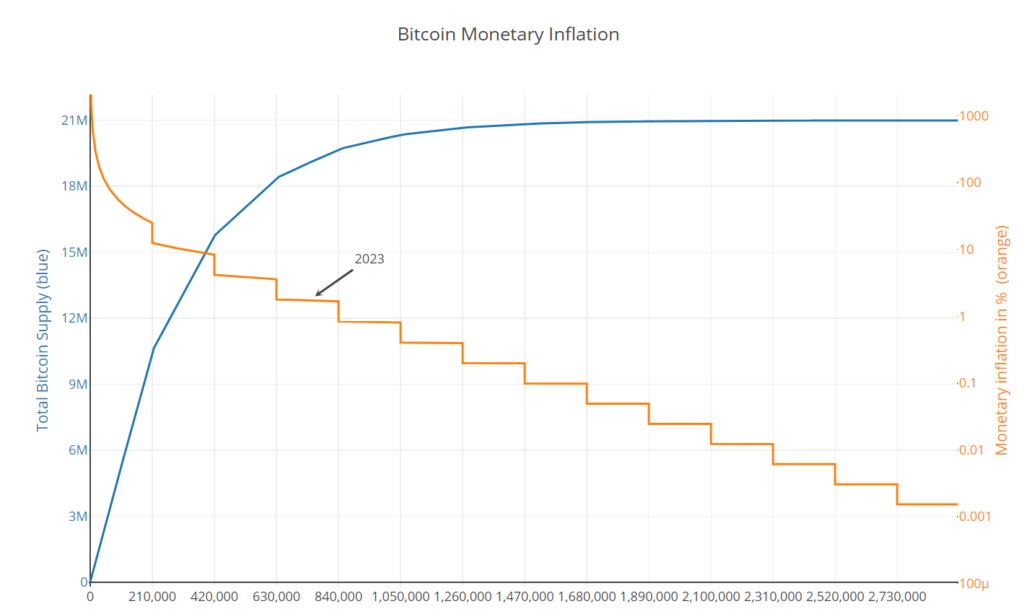
That means Bitcoin today has a similar scarcity profile (or emission rate) to gold and it would therefore have the right properties to serve as a store of value for investors in the long term.
The key characteristic of Bitcoin is that unlike gold, it cannot be confiscated and it cannot be banned in practice: Because of its dezentral nature, there is no central authority or government that can change the Bitcoin network’s monetary policy, issue more Bitcoin, block transactions, or take Bitcoin from an address. Furthermore, you can self-custody your private key for your Bitcoins on paper, on a hardware wallet, stamped on a titanium plate or memorised in your head with a seed phrase. You can even split your key into several parts and hold each part in different ways in different locations. Lastly, while a gold bar weighs around 12 kg, Bitcoin is digital and can therefore be bought, sold, and transferred borderless and as easily as a text message.
Take away
Throughout history humans have used 3 types of money. “Fiat money” as we use it today, has been in circulation before, often ending in stark devaluations of the currencies and a return to hard money.
Today, with increasing debt levels and repeated money printing, the risk of monetary devaluations is rising and it is possible that we will see a return to hard money in our lifetime. Gold has traditionally been the fallback hard currency, however we would argue that Bitcoin with its unique properties could have a role to play as a digital store of value.
Further Reading
Ray Dalio – The changing world order: Why nations succeed and fail