Once again, crypto made negative headlines in newspapers across the globe. This time with the bankruptcy of FTX, the second largest centralized exchange in the crypto space at the time. At the center of the collapse is the quant trading company Alameda which shares the same founder and grew in tandem with FTX to being one of largest liquidity providers in the industry. From what is currently known, the two companies benefited greatly from each other until Alameda’s balance sheet was leaked by Coindesk. It was the catalyst to bring it all down and shake the industry to its core. Apparently, large portions of its assets were held in FTT and SOL. The first is FTX’s own token and the second came from early investments into the Solana project and its ecosystem. It sparked concern whether Alameda would become insolvent, should those assets fall in value. The mentioned tokens got under heavy sell pressure and a bank run on FTX began taking place. When FTX then stopped withdrawals, evidence was mounting that customer funds were missing on FTX and suspicions grew that they had been lent to Alameda. After less than a week, FTX Int., FTX.us and Alameda all filed for bankruptcy. Detailed rundowns of the catastrophe that unfolded upon the crypto space have been written by Crypto Finance as well as Arthur Hayes. We refrain from reiterating the story or taking part in the circulating speculations. What deserves emphasis however is the fact that similar to the downfall of Three Arrow Capital, crypto did not fail. It was fraudulent behavior and excessive risk-taking with overextension from leverage done by unregulated entities.
So what does this mean for the industry?
What already took place is deleveraging. But the looming short term risk is contagion. The list of institutional investors in FTX and Alameda is long and we expect the falldown to ripple through the ranks. The most exposed entities are lenders and (hedge) funds. In the last couple of days, the first institutions began declaring their losses due to the collapse of FTX. BlockFi, a lender that had already been under heavy pressure after the collapse of Three Arrow Capital, appears to be heading for bankruptcy. Genesis, another major lender, halted their withdrawals and are facing a serious liquidity crunch. The next couple of weeks will likely wash ashore more affected participants.
Self-Custody as the only solution?
Over the last years, centralized exchanges gained more and more trust among the industry. No major exchange had been caught with fraudulent actions, at least not the larger ones. But in light of the latest events, distrust of unregulated centralized players (exchanges or lenders) is back to all time highs. The call to remove assets from those platforms is repeated over and over again. While we agree that self-custody is one of the most powerful arguments crypto makes for itself, we believe it is not yet fit for every user. But several platforms chose the path of regulation acquiring licenses for their offerings in many operating countries. A concrete example is Coinbase. They are maintaining licensure in nearly every US state and obtained a BitLicense from the NY Department of Financial Services in 2017. Back in August, Blackrock and Coinbase announced their partnership giving Blackrock’s customers access to Coinbase’s trading and custody solutions. Since we have a strong focus on regulation, neither us nor any of our partners have been affected by the latest events.
How low can we go?
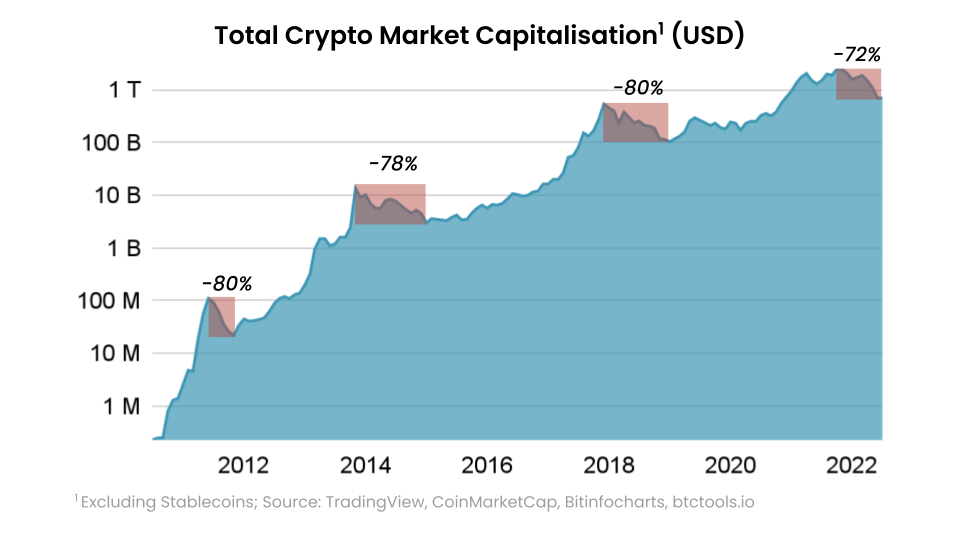
While the contagion poses a threat to the price development in the short term, we assess the latest events as painful but necessary deleveraging of the industry. Crypto proves time and time again that the technology is sound and has the potential to disrupt existing industries in the coming years. From a macro perspective, we think that now is the time for longterm investors to reassess their position in the market.
Further Reading
Crypto Finance – FTX Collapse Postmortem