In our previous Report 1 – Crypto is dead. Again., we talked about the promises of the “Internet of Value”. On the path to reaching this vision, Ethereum has recently undergone the Merge marking one of its biggest milestones. Since it was one of the most anticipated events of 2022 in the world of crypto, we want to discuss it here and put it into a macro perspective.
Why merge?
The ethereum network acts as one of the base layers of the internet of value. As such, it needs to be able to scale with the growing number of applications built on top of it. Prior to the Merge, Ethereum used proof-of-work (PoW) as a consensus mechanism resulting in two main issues in keeping up with its success. The first being a constant block emission (i.e. its transaction throughput) of roughly 12 seconds per block. The second was a high and growing energy consumption (~80 TWh per year). Since this rate was fixed, more demand resulted in higher transaction costs and network congestions.
With the Merge, the Ethereum network changed its consensus mechanism from PoW to proof-of-stake (PoS). Ethereum’s roadmap focuses on three aspects: scalability, security, and sustainability. The Merge tackled sustainability directly and set the groundwork for scalability. With PoS, the network has reduced its energy consumption by 99.95%!
Misconceptions
Now that we understand the motivation for the switch to PoS, let’s quickly go over the two most common misconceptions about the Merge:
Reduced gas fees & higher transaction throughput: The Merge was a change of consensus mechanism, not an expansion of network capacity, and was never intended to lower gas fees.
Faster transactions: Though some slight changes exist, transaction speed is mostly the same on layer 1 now as it was before the Merge.
This concludes that no visible short term benefit occurred for the user in terms of usability. Users still have to pay the same amount of transaction fees and experience the same speed.
Narratives and how the are playing out
A lot of hype has been generated around the Merge raising various expectations. Let’s shed some light on the most discussed topics of the community going into the Merge and how they played out so far.
Saving Energy
With sustainability being one of the three pillars of Ethereum, we already discussed that PoS was able to slash the network’s energy consumption by 99.95%. A huge achievement! However, this raises the question, where did all the miners go? If you invested in expensive mining equipment, surely you won’t just stop your business? As it turns out, there are 2 main directions miners took besides shutting down:
- Change the network you mine for. This means the consensus mechanism needs to be similar to Ethereum’s to make the hardware competitive. The two most important networks are
- ETHPOW: A new fork of Ethereum which keeps using PoW as a consensus mechanism has been introduced by miners. At the time of writing, its hasrate is at about 60 TWh.
- ETC: Ethereum Classic, an old fork created in 2016, saw its hashrate skyrocketing from about 40TWh to now ~200TWh.
- Look for an alternative business model like Hut 8 Mining Corp does
A stream of professional miners coming from the massive mining capacity of Ethereum to other smaller chains with already saturated markets will probably lead to high competition and eventually many players being forced out of the market. So if prices of the smaller assets miners migrated to should not increase drastically, it is safe to assume that only the most efficient one will stay competitive and survive.
ETHPOW
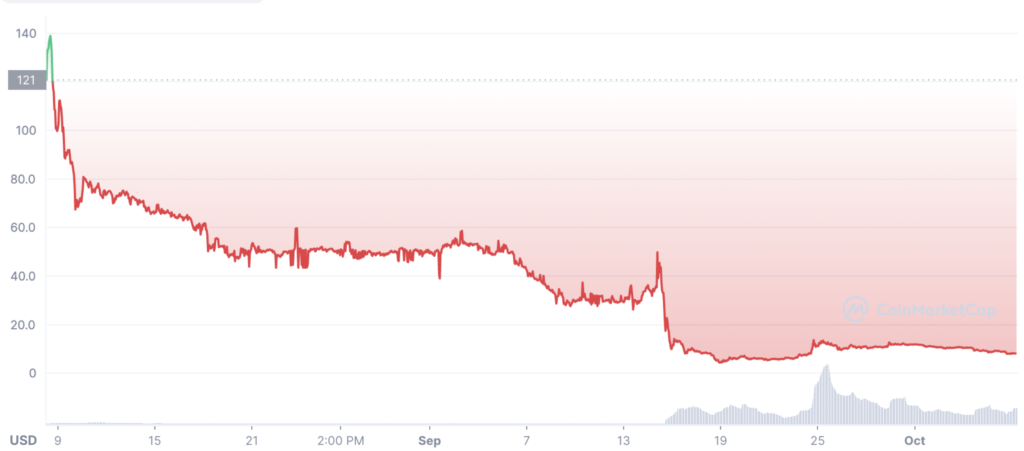
Miners knew that after a successful merge, they could find themselves out of business. So in anticipation of this, they announced a hard-fork of the Ethereum Blockchain called ETHPOW. It is essentially a continuation of the status quo. In the past, hard-forks turned out to be lucrative events for investors with the most prominent examples being Bitcoin Cash, Litecoin and Ethereum Classic. Besides the monetary aspect, investors worried about an ideological struggle dividing the community. Out of the gate, the new consensus mechanism of Ethereum worked flawlessly while ETHPOW was marked by technical difficulties. The price for ETHPOW futures prior to the Merge rose temporarily over 60$ and then came crashing down to about 10$ at the time of writing. One of the main factors for the valuation is a vibrant ecosystem. We currently do not believe that a majority of decentralized applications will run a service for ETHPOW. An example for the prevailing skepticism is for instance Uniswap. As of now, we think ETHPOW does not have a successful future.
Sovereignty
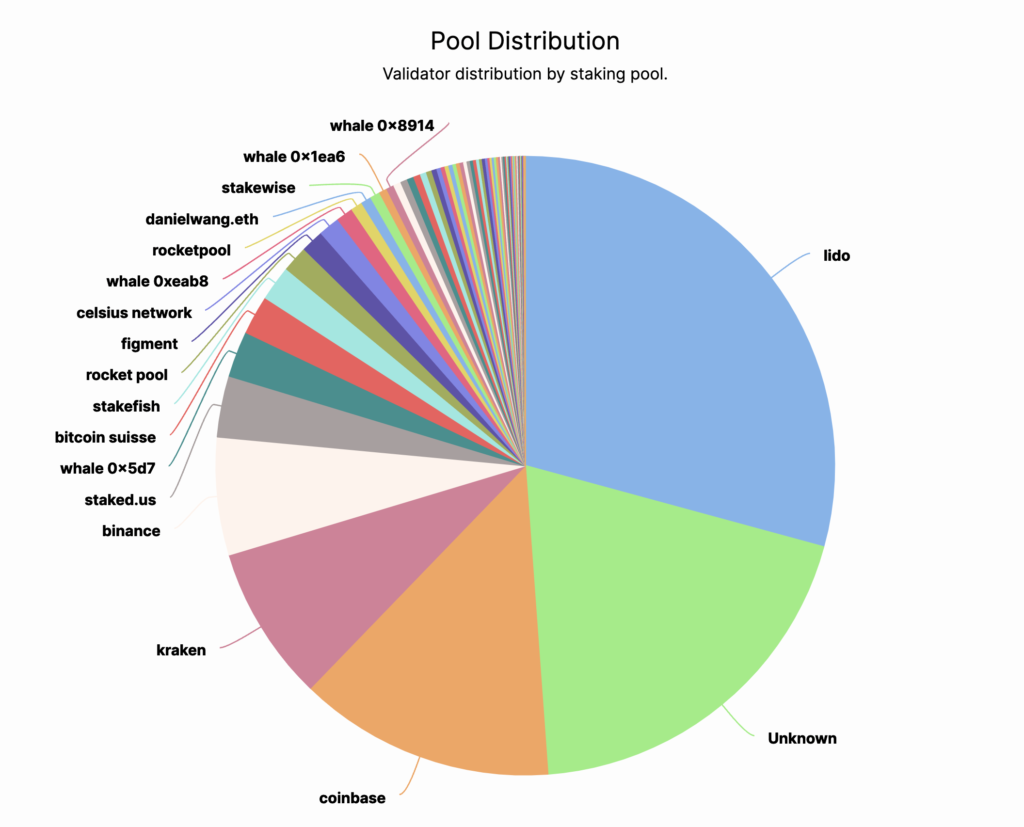
One of the fundamental arguments for crypto is its censorship resistance. What makes this possible is a widespread decentralization. It is where Bitcoin and prior to the Merge Ethereum excelled compared to highly centralized blockchains such as Solana and Binance SmartChain. This results in the fact that governments or other malicious parties cannot influence which transactions are added (or not added) to the blockchain. In theory, this still holds for PoS which is equipped with a set of rules that make attacks on the sovereignty of the blockchain expensive. But the current problem Ethereum seems to face is a dense and US concentrated stacking activity. The reason for this is due to high entry barriers for being a validator (validators add new blocks to the chain and control other validators). As a consequence, users pool their assets. This means, you participate from the rewards the pool is receiving but give up control of how the validator operates. Currently, two pools (Lido & Coinbase) together produce roughly 43% of all blocks. In theory, having control of 33% could already damage the blockchains integrity severely. The CEO of Coinbase Brian Armstrong is well aware of this problem and emphasizes that while Coinbase will follow the law, they rather shut down their staking services than let pressure from outside affect their integrity. He argues that users can withdraw their assets in case of a lack of trust and advocates more decentralization by working towards self-custody.
Price Action
Boosted by the excitement, Ethereum outperformed Bitcoin over the two months leading up to the Merge. What followed was a stark correction starting about a week before the Merge occurred. Classical play of “buy the rumor, sell the fact” it seems. But what’s more interesting for investors is the influence of the Merge on the long term valuation of Ethereum. So let’s go over two major features and how they might affect the price:
Changed Tokenomics: The tokenomics of Ethereum are mainly influenced by two factors: issuance and burn. With each added block, a certain amount of Ether is issued for finding and validating the block and some Ether is burned in the form of transaction costs. Prior to the Merge, Ether was issued to miners and validators. The total supply growth i.e. inflation was ~4.62%. After the Merge, issuance for miners stopped completely while validators continued to receive the same amount. The resulting supply growth is ~0.49%. On the other hand, the burn mechanism remains untouched. Since the amount of Ether burned is the sum of transaction costs and they in turn are influenced by the network’s workload, the change of netsupply varies with the demand of the network. Since the Merge, Ethereum has undergone a change from an inflationary token to a stable netsupply. A website to monitor the current dynamics can be found here.
Release of stake ETH: The Ether that validators staked for participating in PoS and rewards that they receive are locked (currently roughly 13.4 million ETH which can not be withdrawn). The fact that all issued tokens are automatically locked and validators are not able to withdraw their stake renders Ethereum temporarily deflationary. It was originally planned for withdrawals to be activated in the next upgrade called Shanghai (announced to take place in the next 6-12 months after the Merge). However, developers recently confirmed that the upgrade will likely not include this feature leaving investors in the dark when they can withdraw their assets.
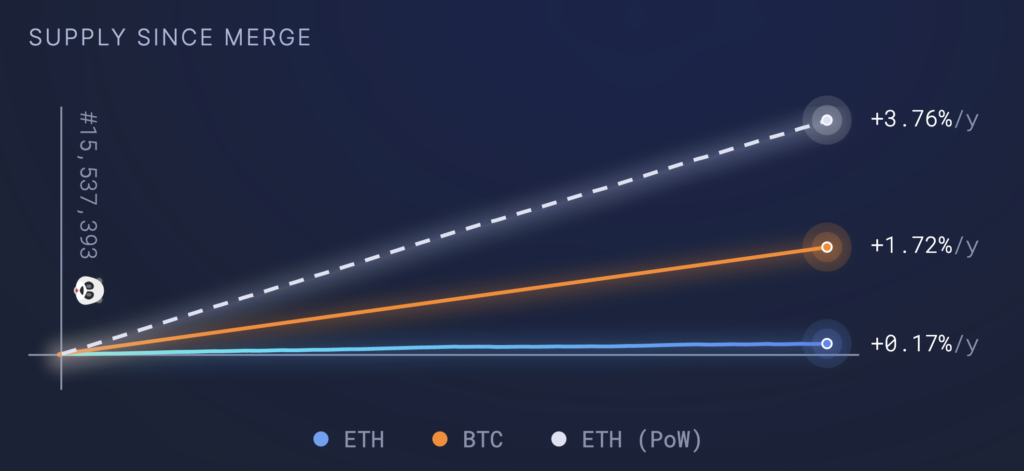
Essentially, the changed tokenomics result in a shift of the supply curve. It became less elastic. One can argue that the successful Merge and many of its implications have already been priced in some time ago. However when market sentiment turns bullish once again it will have a much greater impact on Ethereum’s price now than it had before the Merge. Given these implications, Ethereum offers an attractive opportunity right now.
In this article, we tried to cover as many interesting aspects of the Merge as possible. Therefore we didn’t go into detail. If you are interested in how Ethereum or crypto assets in general work, we love to chat.
Further Reading
Ethereum Foundation – The Merge
Ethereum Foundation – Upgrades