The most recent developments in the crypto markets have resulted in bearish sentiment among investors, fueled by crushing headlines and lurid statements from publicly exposed financial experts. It has been a field day for all those vocal critics from traditional finance, who now feel vindicated, as they had said all along that crypto assets are only useful to kidnappers, worse than rat poison squared or even just an index for money laundering. At first sight, it almost feels like 2018 all over again. But let’s have a look at why we think this time is different.
As the usual opponents of this emerging industry keep barking, many institutional investors have already recognized the potential of this asset class and have been actively embracing crypto as a diversification to their portfolios – despite (or because) of its volatility. While it has been mainly retail investors throwing the party back in the days as early adopters, one can say that with numerous top tier institutional financial companies such as Blackrock entering the space, crypto assets are becoming mature and are on the right path to establish themselves as a new asset class.
But what are the reasons that eventually let these big institutions such as the likes of JP Morgan, Schroders and Goldman Sachs change their approach to crypto? While market participants and new investors can get easily distracted by the flood of emerging projects within this fast paced industry, those institutions steer clear of impulsive decisions driven by emotions like FOMO (fear of missing out). On the contrary, institutional investors (should) look at fundamental metrics such as a growth rate, adoption and market size as important decision factors.
The primary goal of this blog post is to briefly explore some of these factors as well as the underlying fundamental value proposition of crypto assets which, to our belief, drives the current offstage wave of institutional adoption.
The future is crypto and it is happening now
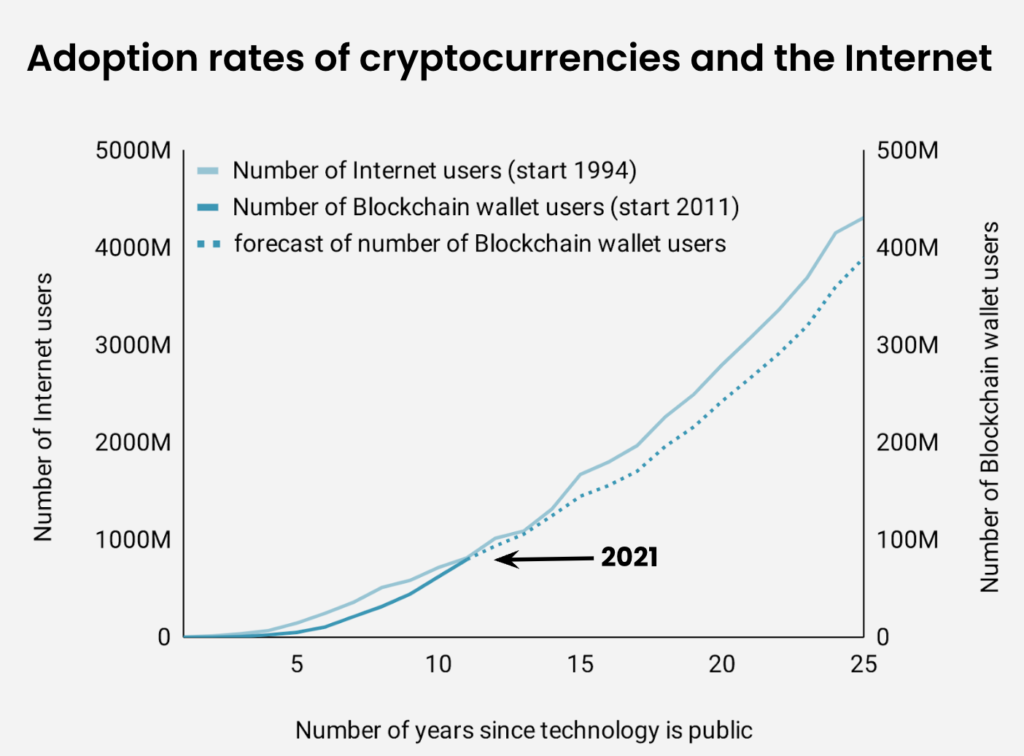
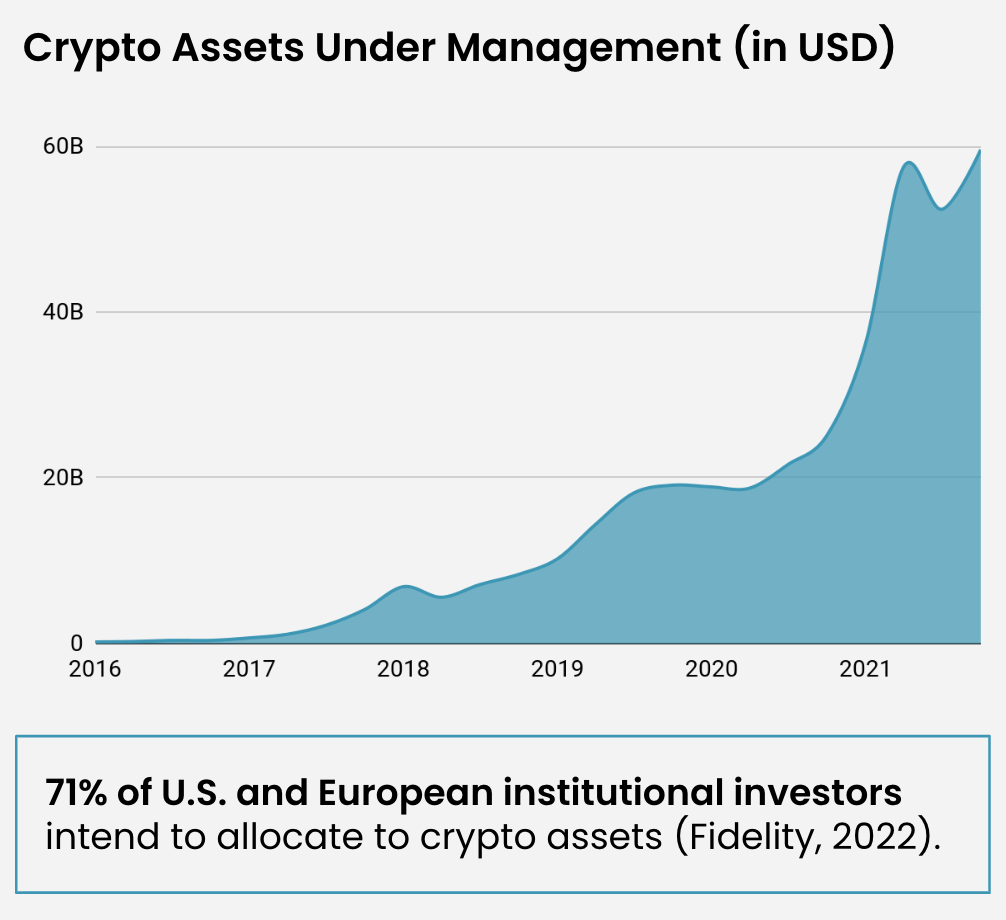
With an adoption growth of over 800% in 2021, there are many similarities to the emergence of the internet which suggest that crypto might also enter an inflection point of hyper-adoption (see chart 1). This rapid growth comes as no surprise as increasing regulatory clarity underpins the growing belief that crypto markets are maturing and suitable for investment from a wide range of investors. Looking at the growing appetite of institutional investors we see the same picture unfolding (see chart 2).
Investing in crypto is a long-term bet. Long-term bets usually entail that investors must navigate through many ups and downs in the market. Thus it is crucial to acknowledge that it is no different in this nascent market that financial cycles and product cycles evolve mostly independently.
Now that we know that smart (institutional) money keeps pouring in and adoption is rising at the same pace as the internet, let us zoom out and ask the most important questions: What is the actual value proposition of bitcoin and crypto assets? What is this bigger picture that some traditional investors are missing?
Crypto as the “Internet of Value”
The internet of value is a concept which envisions a world where value moves and is exchanged like information is exchanged today in the internet (of information) era. While the concept between these two types of internet might sound similar, their technical architecture is different. In today’s internet, most value is created on the application layer. On the contrary, value capture in the internet of value already starts at the protocol layer. Since public blockchain-based networks are powered by crypto assets, it becomes possible to take an ownership stake in the entire internet of value.
This is arguably one of the tricky paradigm shifts new investors must wrap their heads around to understand the full magnitude of crypto. The illustration in chart 3 should help to grasp the main idea.
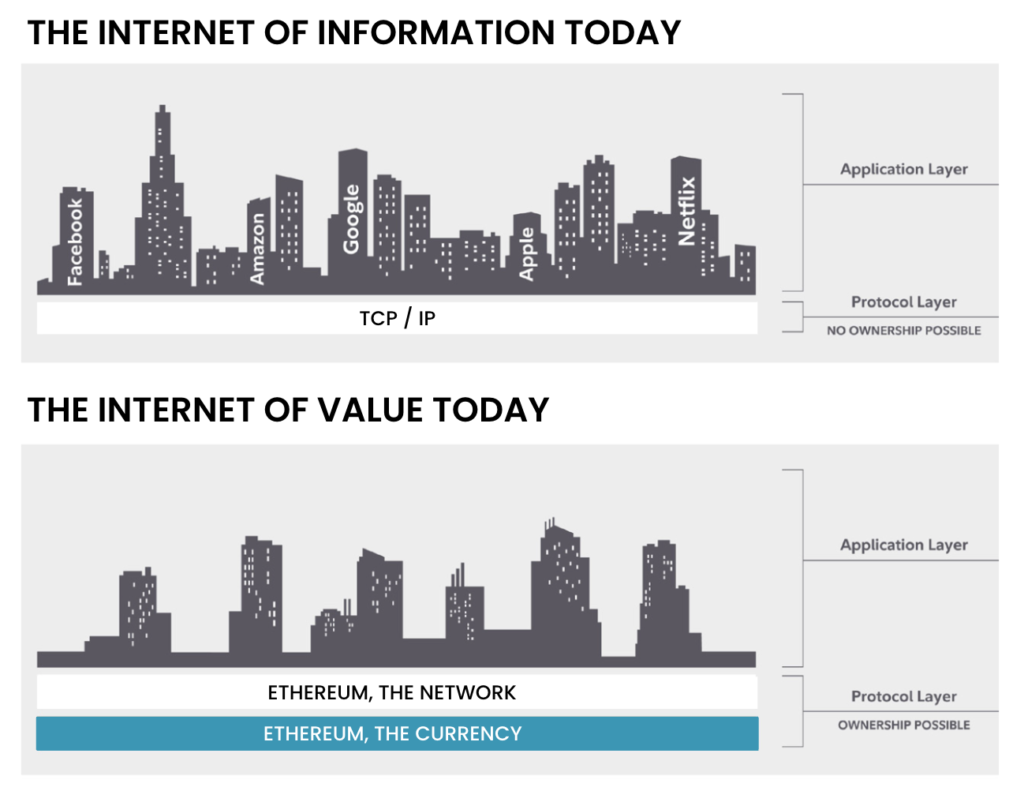
This architecture allows investors to own part of the base layer of this new technology and therefore allows for the investment strategy to be relatively agnostic about what specific applications are built on top of it. It would be akin to being able to own the base layer of the internet and getting exposure to all of the innovation on top (e.g. Google, Amazon etc.).
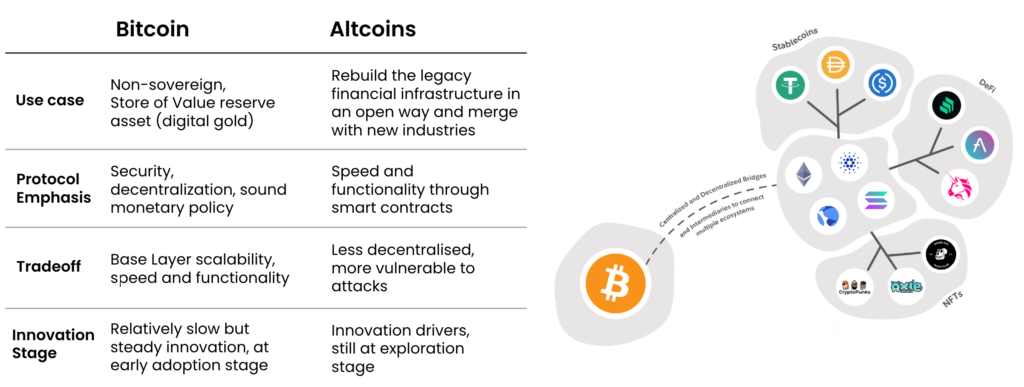
Due to this fundamentally different base layer, crypto assets are essentially breaking up the entire financial system as we know it by redefining its entire value chain. Within this thriving asset class, we have to differentiate between Bitcoin and the rest (see chart 4 below). While Bitcoin as the sole digital bearer asset aims to serve as a store of value for the digital age, most blockchain-based applications (DeFi, NFTs, Web3 etc,.) are rebuilding the legacy financial infrastructure in an open way that consequently breaks up the lines between different industries such as Art, Gaming or IP. These applications are powered by other networks such as Ethereum or Solana (altcoins), which belong to the strongest innovation drivers that attract investors and users alike.
Without having to go into details of the use-cases of these applications (which would go beyond the scope of this article), the information provided should already let you grasp the bigger picture. Let’s break it down: The present is digital. Throughout our day, we interact digitally or rely on digital services and data. While many business models have been disrupted along with the emergence of the internet of information, other parts have not evolved in the same fashion and still rely on outdated technology and practices. Although the user experience became more digital over time, the systems running it in the background have not or barely changed. That is the case for almost everything which requires the transfer or exchange of value. Blockchain-based assets are changing that.
The future will be even more digital. Everybody will spend more time in digital worlds and will therefore also own more digital property. All services and products will become more interconnected. As a consequence, also our access to digital data will become even more ubiquitous, interconnected and valuable. Now imagine that we have an entire industry today that works on solutions that set the cornerstone for this very digital future. A world with seamless integration of technology. In the open and interoperable digital asset economy, global and permission-less financial as well as non-financial services set the new standard. This eventually opens up vast opportunities for the empowerment of users, but also for creators, artists, public services and mostly for new and industry-overlapping business models. The bottom line here is that every business will be built on or connected to the platform which inherently allows a direct (peer to peer) exchange and transfer of digital value. And users will eventually use the platform where they have easy and borderless access, high control and security/privacy.
Why society will embrace the “Internet of Value”
In a digital economy, customers are in control. They have access to information like never before. This is the main reason why the internet of information eventually shaped many industries such as (e-)commerce, travel or entertainment. Now, in the digital asset economy, customers are also in control. But this time, users do not only have access to new and better services, but they can store, transfer and exchange value as easily as never before. Since users do not have to rely anymore on traditional intermediaries with quasi-monopolistic power, services become more cost efficient, faster, more secure/private and there are more alternatives to choose from.
As this digital shift unfolds in front of us, we have already witnessed the consequences of not owning our digital data (social media). As a result, majorities think that personal data is less secure today and feel a lack of control over personal data collected by both private companies and governments. The permission-less and decentralized economy promises the contrary, where users will be able to claim back data ownership and eventually have their own say when it comes to management and the monetization of their personal data.
The same trend is reflected in the declining trust in institutions (both private and public) which reached a new low this year in the US. Reasons for this downward trend cannot be identified clearly and range from the impact of (social) media to polarization of political views according to researchers. However, as more and more millennials run our world, their strong distrust in traditional institutions will shape the future and therefore also the emergence of the “internet of value”. We believe that this generational shift will ultimately lead to the unfolding of decentralized networks built on integrity that provides permission-free access. If this won’t lay the foundation for the digital age, what will?
—
What are your thoughts on the institutional adoption of crypto and the concept of the internet of value? If you have questions or would like to discuss related topics, please reach out to us – we’d love to chat.
Further Reading
Cerno Capital – The Internet of Value
Blockchain: From Bitcoin to the Internet of Value and beyond