Over the last months, news coverage around crypto assets focused on price declines and bankruptcies, leaving many investors unsure about the reasons behind the decline and the current state of the market.
In this article we would like to take a step back to put the recent developments into a long-term perspective, as well as share our view of what drove the recent market sell-off.
Zooming out
To understand what happened over the last year, we first have to take a step back and look at how the crypto market evolved since its emergence in 2010. The total crypto market capitalisation (i.e. market value of all crypto assets) has risen to close to 1 Trillion USD:
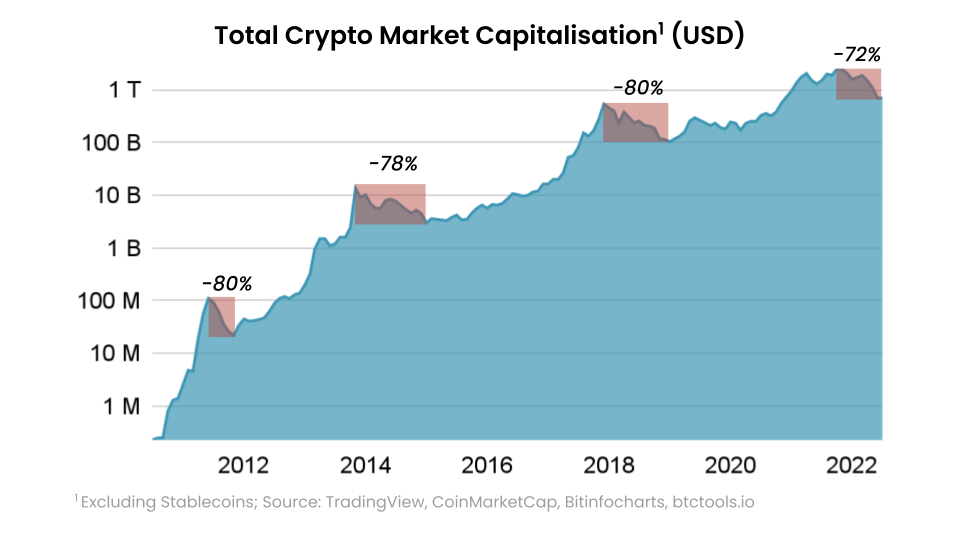
However, during this strong growth trajectory, the market has experienced several corrections of over 70% (in 2012, 2015, 2019). In that light, the 2022 sell-off in crypto assets appears less as a catastrophic market crash and more as regular correction which is inherent to the volatile nature of the crypto market.
In light of these large price declines, it is easy to forget that any long term investors who invested into Bitcoin or Ethereum (the two dominant crypto assets) before 2021 still enjoy a net positive performance at current prices.
| Performance as of August 2022 | 1 Year | 2 Years | 3 Years | 4 Years | 5 Years |
|---|---|---|---|---|---|
| Bitcoin | -42% | 97% | 124% | 206% | 752% |
| Ethereum | -37% | 321% | 650% | 289% | 622% |
The post COVID boom
Now that we understand the larger context, let’s dive into the more recent developments: In response to the COVID-19 crisis, central banks and governments injected liquidity into financial markets and the economy at an unprecedented scale. In the light of record low interest rates, both professional and retail investors went after alternative asset classes, fueling a run-up in prices for innovative crypto assets. In 2021 these price advances were further reinforced by excessive risk taking and leverage:
- Futures: Retail investors used new derivative financial products (mainly Perpetual Futures) to place leveraged bets on crypto prices in hope of quick returns.
- Financial engineering: Investors and crypto companies lent each other assets with “risk-free” returns of over 10% p.a. that were then used for further lending or leveraged investment bets.
After an initial price peak in the spring of 2021, prices for crypto assets stalled and despite record amounts of money inflows and leveraged bets, the price advances slowed down considerably. By November 2021 all our quantitative risk indicators were flashing dark-red, indicating unsustainable levels of leverage in the market and a high risk for market crashes.
The unwinding
Only when the tide goes out do you discover who’s been swimming naked.
Warren Buffet
In its fragile state, the market then faced a series of events that ultimately reinforced each others negative effect on prices:
- By the end of 2021, the FED (US central bank) signaled that it would significantly downsize its balance sheet and raise interest rates aggressively to fight inflation. This led investors to reduce their allocation to crypto assets. Coupled with a high leverage, this in turn led to a series of liquidation events (mini-crashes) in December 2021 and January 2022.
- Faced with initial losses and a more challenging macro environment, investors started pulling out of high risk financial engineering projects (e.g. Experimental Algorithmic Stablecoins: Luna/UST). In the absence of trust and sufficient buy volume, prices for these assets spiraled downwards.
- As losses started adding up and trust evaporated, previously aggressive borrowers found themselves unable to repay their loans and filed for bankruptcy (e.g. the Hedge Funds Three Arrow Capital or the Centralized Lending Platform Celsius)
In our view, the market crash of 2022 needs to be understood in the context of its fragile state by the end of 2021, as the extent of the price declines cannot be explained by individual events. In the unwinding process, investors were forced to involuntarily liquidate billions in crypto assets.
We believe that in the same way the excessive leveraging of 2020 and 2021 led to an overshooting of prices, the deleveraging mechanisms playing out in 2022 have pushed prices to very low levels.
Given these recent selling pressures and the longer term context, we believe it is an interesting time for investors to reassess their allocation to crypto assets in their portfolios.