Intro
In this blog post, we break down the Mellivora strategy and its underlying mechanics. To understand where the strategy is coming from, we start by explaining our view on volatility in crypto markets and their implications. We then derive the core algorithm and the strategy that leverages the quantitative approach.
Volatility
The motivation behind the Mellivora Strategy is rooted in the market dynamics of crypto assets. Crypto assets performed extraordinarily well in past bull runs. Bitcoin impresses with an annualized yield of 150% over the last 10 years. On the other hand, those runs were always accompanied by stark corrections of over 70%. To visualize this, we isolated the bullish and bearish bitcoin market phases of the past years in the following chart. The logarithmic scale puts the major moves into perspective and makes the huge percentage gains comparable to the subsequent drawdowns.
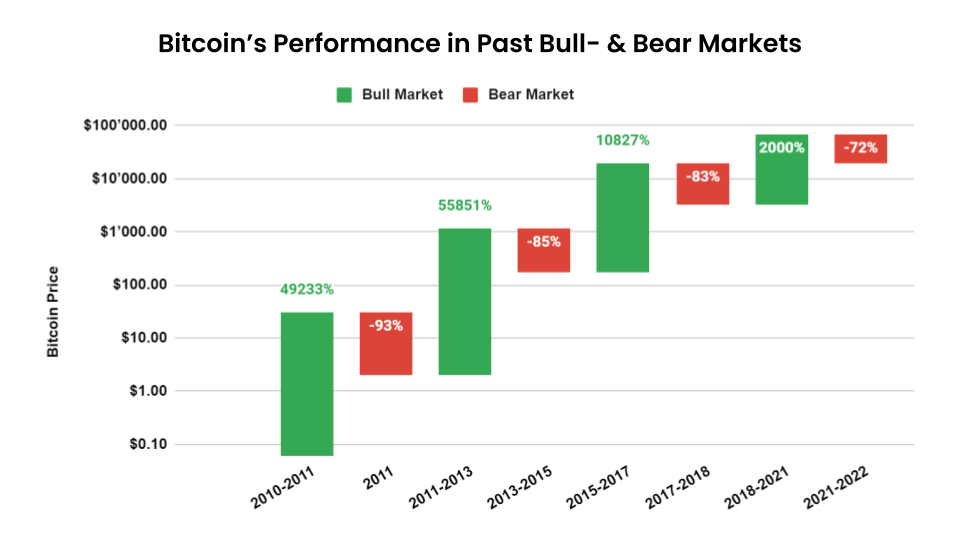
Bitcoin has already lived through 4 major bull runs, with returns exceeding several 1’000%, and each run was followed by a deep bear market.
This volatile market dynamic makes an excellent case for an active investment strategy. We at Mellivora Capital believe that a participation in this nascent sector is highly attractive but being able to actively manage the risk is of utmost importance for sustainable long term gains.
Deep dive into sources for volatility
To implement a strategy that successfully manages the risk, we need to understand the driving factors for the volatility first. On a macro perspective, we can argue that the market and its underlying technology is still in a nascent stage and is thus prone to higher volatility than mature markets. However, if we have a look at shorter timeframes, we still see significant rallies and short but heavy corrections. From our research, we distilled the two major contributors. On one hand, new technological advancements are being explored and developed. This leads to additional value for the crypto market, an inflow of fresh capital and therefore rising prices of the altcoin assets. We label this “positive volatility”. On the other hand, the market participants are enticed to exuberant behavior and excessive risk taking which in turn results in flash crashes. We label this “negative volatility”.
Our experience suggests that positive volatility is characterized by a bullish period where the altcoin market tends to outperform Bitcoin. During this time, the increased risk of holding altcoins in relation to Bitcoin is favorable. But an overextension of this period often results in excessive risk taking by investors. This increases the risk of stark corrections which favors exiting the market and waiting until a cool down has happened.
How we navigate the market
We now deducted what the volatility drives. To make it actionable through a quantitative approach, we need to be able measure the volatility. For this, we primarily turn to the crypto futures market. By July 2022, the futures market outweighs the spot market by a factor of 40 in terms of trading volume. Additionally, Binance and other major exchanges allow their clients to invest in futures assets with a leverage of up to 100x. Naturally, the higher the leverage investors apply, the higher the risk of complete losses.
We developed an algorithm feeding on sentiment signals from futures markets for a nuanced risk assessment of the overall market. Optimised with state of the art machine learning approaches, the algorithm is designed to condense over 100 signals into two metrics quantifying the opportunity and risk of future positive and negative volatility.
The regime framework
We succeeded in quantifying both the positive volatility as well as the looming risk for flash crashes due to excessive risk taking of investors. To create an active trading strategy, we now introduce the final piece of the puzzle which is the regime framework. It consists of three risk regimes. Depending on the two metrics, the appropriate regime is chosen. The three regimes are as follows:
- Neutral: The market is in a healthy state. Participation is therefore favored.
- Bullish: Participants are bullish on the market and altcoins are outperforming Bitcoin.
- Overheated: Leverage is high and the risk for larger corrections is increased outweighing potential further gains.
In a neutral regime, we chose Bitcoin as the primary investment. It brings the most stability and has been on the forefront since the very beginning.
While being in the bullish regime, an outperformance of altcoins compared to Bitcoin is expected and therefore we allocate the portfolio to an altcoin basket.
If the framework determines being in the overheated regime, we eliminate the risk by cutting the crypto exposure and wait on the sideline with cash until the risk of crashes has been reduced. The following schematic explains the framework visually.

In this article, we explained the concepts of our quantitative approach and how the Mellivora strategy works under the hood. If you would like to get us into more detail about how we identify and measure volatility, contact us, we’d love to chat.